Are the tens of thousands of workers who find day jobs via the Temper platform freelancers or temp agency workers? This is the question that has been on everyone’s minds since 2020, when the FNV’s legal case against Temper began. Following a ruling in Temper’s favour in 2024, a less favourable ruling for the platform followed in 2026, in which the judge ruled that Temper is, in fact, a temp agency.
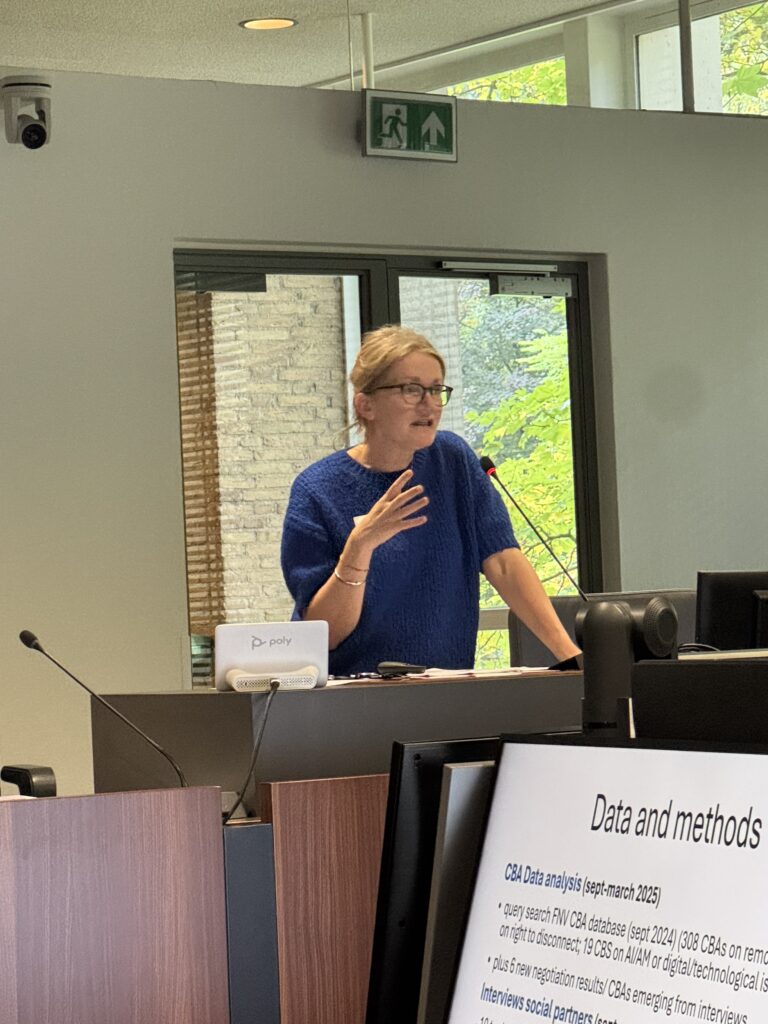
On 17 June 2026, I was invited by BNR News Radio to join Thomas van Zijl to provide some insight into this case and offer unsolicited advice to the platform company’s new CEO. I discussed the various legal cases against platforms in the Netherlands, how the platform operates and the expected next steps.
I have been following this development from the start. For instance, in 2020, I conducted research into this phenomenon with Jeroen Meijerink. The conclusion at the time was that day jobs can also be carried out via a temporary agency arrangement, but there are certain restrictions on both sides. And that the term ‘security’, which crops up in many discussions, is rather disappointing. In the meantime, the regulation around temp agencies has been amended and has since become less flexible.
What was my advice to the CEO? Firstly: appeal to the Supreme Court (Hoge Raad). I cannot imagine Temper not doing this. The FNV trade union would have done the same had it lost. The two years this took at Helpling and Deliveroo also buys time. Secondly: open up the public and political debate further. Temper has always been very secretive externally. It’s time to break that open. Via platforms such as Temper, tens of thousands of workers have carried out gigs to their satisfaction. But we still know too little about this. What are the elements that work and appeal to people? Engage in dialogue WITH one another more; don’t just talk ABOUT one another. This, incidentally, is also advice for the trade unions. But it applies to policymakers too: after all, they are the major absentees in this debate. And finally: anticipate. The fact that there’s also a Temper temp agency app shows that work is already in progress.
I also hope that the discussion will focus more on work, certainties and obligations than on legal classifications. There will always be a grey area. Explore how you can agree on more contract-neutral or contract-transcending obligations and certainties. Within the platform economy, you can already see this happening under the Platform Work Directive (European) and the ILO Platform Work Convention (global). If we narrow the gap between the two, the incentive to ‘shop around’ will also be reduced, and we can get back to discussing the substance. To achieve this, parties must look beyond their own self-interest. And that is perhaps the greatest challenge facing the labour market.
From 1 to 12 June, representatives of workers, platform companies and governments from around the world will gather in Geneva at the International Labour Organisation (ILO) to discuss an international ‘ILO Platform Work Convention’. This is a unique event where the interests of all workers on the labour market will be addressed. In this blog, platform expert and researcher Martijn Arets looks ahead from an international perspective at what will be discussed and what is at stake.
Having become popular in sectors such as food delivery and taxis, there is now virtually no sector in which platform companies are not active. The platform economy is also sometimes referred to as the ‘incubator and testing ground’ for technology in the labour market, indicating that the impact of developments within the platform economy and the way it is structured has consequences for the entire labour market.
Although platform work is often viewed from a local, national or continental perspective, it is also a global phenomenon in many respects. Platform companies often operate internationally and, in the case of online work, the supply and demand for work are often located in different countries, and in many cases on different continents. Furthermore, platform companies keep a close eye on one another, meaning that a working method or business model in one country can quickly gain a foothold in others. Reaching agreements on platform work at a global level is the subject of this and next week’s 114th International Labour Conference in Geneva. Here, representatives of workers, employers (the platform companies) and governments are coming together to negotiate the ‘Platform Work Convention’.
A historic moment
The fact that platform work features so prominently on the agenda in Geneva is historic for several reasons. Platforms facilitate sectors which, even before the rise of the platform economy, were known for the precarious conditions of their workers. Think of food delivery, domestic work, childcare and non-location-bound work that was outsourced to countries such as India, the Philippines, Kenya and Mexico. Sectors, often operating in the informal market, where everyone knew that conditions for workers were frequently harsh. And which, partly due to the invisible (fragmented) nature of the market and the low level of unionisation, meant that governments and representatives could often afford to ignore this group of workers. Invisibility led to a lack of political urgency to take action. Platform companies control these markets as the intermediary between a fragmented group of suppliers (workers) and customers, which drives market growth but also leads to increasing one-sided dependence on and influence by technology. The visibility of these companies and the growing dependence of workers have meant that sectors which were ignored for years are suddenly in the spotlight. The fact that the future of these sectors is on the international agenda is, if you ask me, historic.
Historic also because the process leading up to the convention – read here the ‘draft text’ that forms the starting point for the negotiations – has ensured that workers’ representatives worldwide have come together in recent years to draw up a joint agenda. For instance, a global coalition of more than 30 workers’ organisations, trade unions and civil society organisations published a joint statement in the run-up to the ILC, and last year saw the launch of the ‘Global Platform Workers Solidarity Project (GPWSP)’, a “network of grassroots organisations for platform workers from more than 27 countries, supported by investors, civil society organisations and researchers”. I have never before seen workers’ representatives collaborating in this way across sectors, countries and organisations.
Finally, the discussion in Geneva is perhaps also historically complex. Complex because, despite the stark contrast in interests, representatives of workers and companies must agree on certain points. And complex because the structure of platform work often depends on the sector and the institutional environment in which it operates. And whatever emerges from Geneva must also be translated into national and sectoral levels. This may seem an impossible task, but in my view this is the only way forward: establishing international frameworks and then translating them into national policy.
How platform companies have changed the labour market
Platform work can be divided into both location-bound and non-location-bound work, where unique or generic skills are required and technology has a low or high degree of influence on access, execution, management, price setting and evaluation of work. What characterises the sector is that supply and demand operate in fragmented markets with significant information asymmetry. Work is broken down into small(er) assignments (‘gigs’) and the responsibility that normally lies with an employer has shifted to the individual worker. The platform company, acting as a ‘private regulator’, determines and enforces the terms and conditions of the ‘game’ via technology.
The emergence of platforms in some markets and regions has also led to markets becoming even more fragmented: by subsidising services such as taxi rides, the market was ‘bought’ and competition eliminated, meaning that individual workers could only find work via the platform. At the same time, the freelance model means that platforms can afford to maintain an ‘oversupply’ of workers, as the costs of not having work are borne by the individual worker. This also contributes to growing competition between individual workers and challenges in organising workers.
Delivery rider in Kathmandu, Nepal (Martijn Arets)
In many cases, the work carried out via platforms already existed before the emergence of platforms: even before Uber, Bolt and InDrive, there were taxi drivers, and before DoorDash, Deliveroo and Gojek, meals were delivered by couriers on (motor)scooters and mopeds. Cleaners also cleaned houses and babysitters looked after children whilst their parents went out for the evening. Platform companies have used technology to reduce the search costs between supply and demand, making it easier for both sides to operate in the market and enabling them to organise the market more efficiently. Due to the platform’s central position, there are also opportunities to implement changes centrally for a large group of workers (and customers), thereby influencing market conditions.
The biggest challenges (and solutions)
The central position that the platform company holds in a fragmented market is therefore unique. The challenge lies in the fact that the interests of all participants (demand, supply and the platform company) in a transaction are not always aligned, whilst there is only one party that determines the terms and conditions of the game: the platform company. And how to handle that responsibility, how to give everyone a (more) equal position in terms of information and decision-making, and how to use that position to ensure good conditions for workers is the central question in the discussion. The focus is on understanding and influencing automated decision-making processes, access to data, fair (or: decent) pay where the risks do not lie solely with the worker, and representation.
The lack of insight into automated decision-making processes is a major issue in many platform work sectors. Workers cannot make well-informed decisions and feel pressured by not knowing the ‘regulations’ for accessing the work on which they depend. The impact on workers is vividly described in the blog ‘From Recognition to Responsibility: Worker-Led Perspectives on Labour Standards for the Platform Economy’: “Data workers shared how task allocation is unpredictable, with no visibility into how work is distributed or why opportunities suddenly disappear. Similarly, workers do not know how their performance is assessed, what metrics are used, or how those assessments affect future work opportunities. Such decisions are made with little clarity on how automated processes and human oversight interact. Compounding these opacities, workers have no right to access the data generated through their labour, nor any ability to control how that data is used.”
A lack of access to data contributes to this lack of transparency and the power imbalance between workers and platform companies. In the article ‘Knowledge is power, even in the platform economy’ that I wrote earlier, former Uber driver James Farrar describes how he was hindered by this in a legal case against the platform. He then figured out a smart way, acting as a modern trade union, to obtain data to support his case. My own project, GigCV, shows that it is not at all complicated to share data at the worker’s request, with more than 100,000 platform workers having gained access to their experience data and data having been requested by workers over 32,000 times. My lesson from this is: if you do want something, you make it simple; if you don’t want something, you make it complex. That is why I also advocate being more critical of why systems and processes are made complex. Who benefits from this? Is it to improve the service, or to alter the balance of power and information? In the case of the increasing complexity of methods for calculating pay for on-demand work platforms, I believe the latter is certainly the case here. Enforcing simplification is also a solution in this regard.
Remuneration and the classification of workers are common topics of discussion. Because platform workers are classified as self-employed by most platform companies, the costs and risks that normally fall on an employer now lie with the individual worker. It is widely known in platform sectors such as delivery and data work that workers often earn (well) below the minimum wage. One solution to this, and to other issues, is to employ the worker directly. And although this also has a significant impact on the market, the issue of bogus self-employment is a key item on the agenda in Geneva. I feel it is important to note that in many countries around the world, this does not always improve the worker’s position, and that in some cases where the platform has shifted from freelance to employee status, this has often been organised via subcontractors who also want a slice of the pie. Regardless of the type of contract, it is important that workers are paid a decent wage and that unpaid labour is prevented as much as possible. This is the principle behind the Living Tariff, which I am working on through the WageIndicator Foundation, whereby the costs and risks shifted onto the shoulders of individual workers are factored into the tariff.
Finally, representation. If there is one thing the ILC in Geneva demonstrates, it is that organisations representing workers are increasingly finding common ground. Successes are being achieved at an individual level, such as concluding collective agreements with platform companies and establishing an enforceable minimum tariff or minimum standards. Now is the time to achieve collective successes as well. It strikes me that there is a tremendous amount of information asymmetry in the landscape of worker representation. Not only is it not always clear who represents which workers, but agreements that are made are also difficult or impossible to find. For instance, collective agreements are not public in most countries around the world. And although the underlying motivations are perfectly understandable, this is truly a missed opportunity. Platform companies also benefit from this information asymmetry that is created in this way. That is why it is essential for organisations representing workers to see the bigger picture and also to focus on economies of scale and, as a standard, to make everything as public as possible. WageIndicator has analysed many hundreds of collective agreements worldwide in a database, but actually that is a bit crazy. In my opinion, standardisation and transparency on the part of representatives is a severely under-discussed topic in this debate.
To conclude
The discussion in Geneva is not ‘just’ about the gig economy, but about the rules governing the impact of technology on labour. You might say, ‘I’m not particularly worried about that’, but bear in mind that, certainly with the rise of AI, technology (and particularly the choices we make around it) is having a growing influence on the position and conditions of all workers. This applies also to you. It could simply mean that your job and position suddenly become precarious. This is an extra reason to take this debate seriously regarding the choices we must make concerning the increasing role of technology in the global labour market.
What can we expect during and after the ILC? Firstly: it is a victory for everyone that this topic is on the agenda. It is important to realise that this meeting is not an end point, but a fantastic opportunity to set an agenda and initiate (renewed) collaborations. Improving conditions for workers is a continuous and gradual process. And what will come of it? The outcome of the negotiations must be supported by representatives of workers, employers and governments alike. There are many conflicting interests that need to be reconciled. This could result in a very weak convention being put forward. Or no convention at all. Only time will tell.
Over the years, I have had countless discussions about, and conducted research into, platform work. The conversation often revolves around the same question: are platform workers employees or self-employed workers? It is an understandable question. After all, legal classification determines rights, obligations, representation and protection.
But the longer I follow this market, the clearer it becomes that this focus can sometimes be a pitfall. The employment contract may well be the norm for labour markets in the Global North, but in the ‘Majority world’, where 80 per cent of the global population lives, this is not the case. And whilst lawyers argue over definitions, the market is changing at a rapid pace. Platforms adapt procedures and introduce new schemes before regulations even take effect. Furthermore, in practice I see that a shift from freelancer to employee yields less for the worker than hoped for. Platforms evade their responsibility by working with subcontractors or simply ignore a court ruling. https://open.spotify.com/embed/episode/05LizAO12rsphKL3LZ4DZX?si=z4SBT3snTSCcab39MA1MOw&utm_source=oembed
How can you make binding agreements with platforms regarding minimum standards for platform workers? This question was central to a recent WageIndicator webinar, where researcher Alex Veen from the University of Sydney and Jack Boutros from the Transport Workers’ Union (TWU) in Australia shared their experiences. Their story offers an interesting alternative perspective. Not because Australia has found the answer – nobody has got that far yet – but because there, partly due to the nature of the organisation of the labour market, a fundamentally different choice has been made.
For many years they were bogged down in the question of whether platform workers are employees or self-employed and it was left primarily up to the industrial tribunal – the Fair Work Commission – and the courts to determine the appropriateness of classifications. In the end Australia has opted for a more pragmatic approach: what minimum standards are needed to ensure a sector functions sustainably and safely? That may sound like a subtle difference, but it has major consequences.
A typically Australian solution
To properly understand the Australian approach, you first need to know something about the Australian labour market tradition. Whereas many European countries rely heavily on collective agreements or legislation driven by politics, Australia has had a system for over a century in which labour tribunals play a central role.
The Fair Work Commission – the labour tribunal – is deeply embedded in the Australian system. The idea that the state actively sets minimum standards for sectors is much more common there than in many other countries.
According to Alex Veen, this is essential to understanding current developments.
Australia has not attempted to squeeze a Silicon Valley model into a traditional labour law framework. Instead, the country has built upon an existing tradition of sector-specific regulation. This gave rise to a new intermediate category: ‘employee-like workers’. Not a full employee status, but not the traditional self-employed model without protection either.
An important detail: this category does not apply to all self-employed workers. It is specifically designed for groups of workers who are formally self-employed but have little bargaining power in practice. This is an important detail, given that attempts elsewhere in the world, such as the AB5 legislation in California, failed in part due to their generic approach.
Under AB5, many freelancers, such as journalists who wrote a monthly column for a newspaper, would have been taken on as employees. Meanwhile, the platforms had adapted their model so that they would no longer fall under this legislation.
The approach in Australia is therefore much more targeted and ensures that the discussion shifts from legal classification to industrial relations.
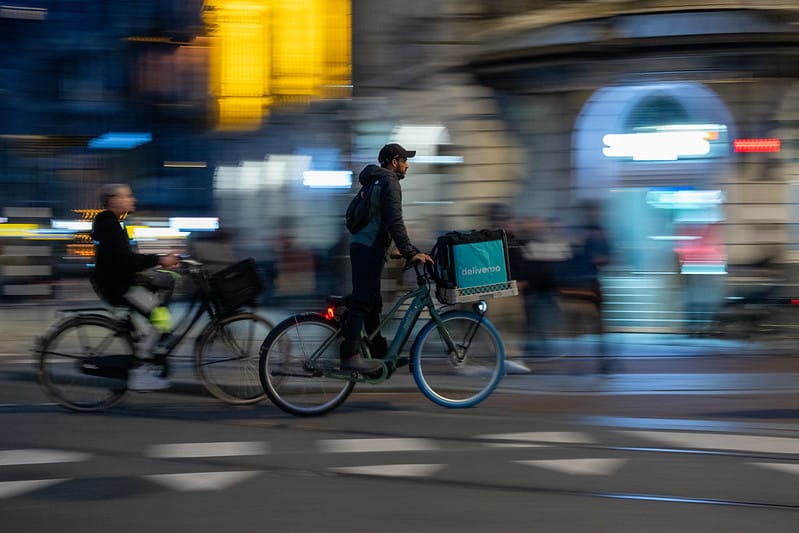
Delivery rider in Amsterdam, the Netherlands. Foto credit: Martijn Arets
Why the transport sector in particular has been affected
The reason why many legal cases concern the legal classification of workers is that the employment contract is seen as the ‘standard’ form of work. Traditionally, the representation of workers is also organised around this, which means that trade unions generally pay relatively little attention to workers who are not employees.
Only in sectors where ‘self-employment’ is common do I see more focus on this group of workers. This was discussed, for example, in an earlier webinar with the Dutch Association of Journalists, which managed to agree on a binding minimum tariff for self-employed journalists. For the Australian transport union TWU, these market dynamics also play a key role in securing minimum standards for platform workers in food delivery, taxi and last-mile logistics.
Jack Boutros explained during the webinar that the union was founded over 140 years ago by workers who bear a striking resemblance to today’s platform workers. Coachmen, delivery drivers and hauliers who were paid per gig, had no fixed wage and were treated by clients as ‘self-employed’. The argument that they were ‘their own bosses’ was already being used back then to avoid social protection.
History seems to be repeating itself with the platform ecomomy. According to Boutros, this is precisely where the strength of the Australian approach lies. The TWU has always had experience organising non-standard workers: owner-drivers, couriers and other contract workers in transport. As a result, the union took a fundamentally different view of platform work than many traditional trade unions. The focus was not on the type of contract, but on the question: do workers have sufficient power to enforce decent conditions?
The race to the bottom was already visible
When Uber entered Australia in 2012 and food delivery later grew explosively, the TWU immediately saw familiar patterns emerging. Fragmented work, intense price pressure, individual workers without bargaining power and, above all, safety coming under pressure.
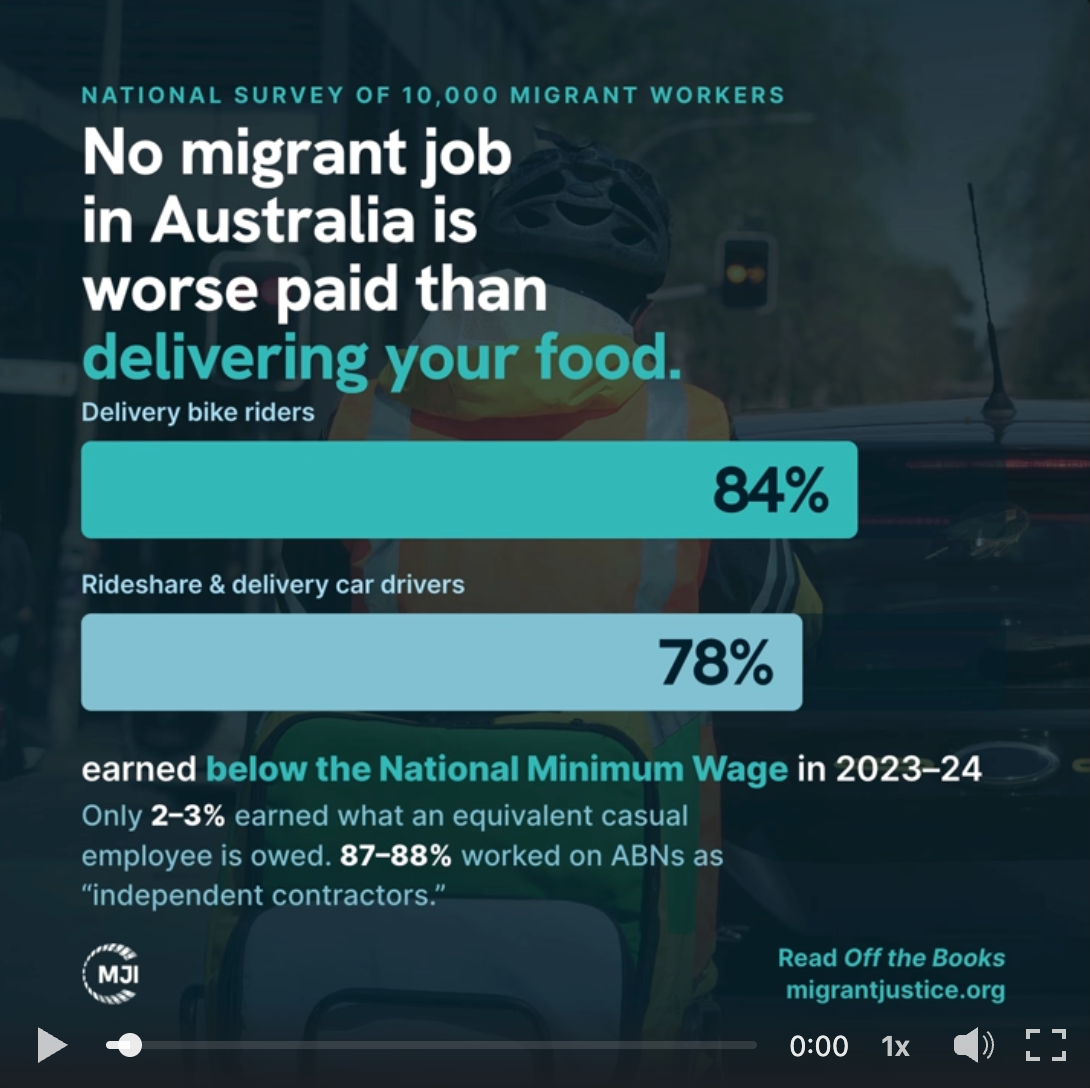
The figures collected by the union in 2018 are striking. Research by the TWU revealed that, after deducting costs, delivery workers earned on average less than half the minimum wage. Seven out of ten delivery workers worried daily about serious injury or death whilst at work, and one in three reported having already been seriously injured.
What is remarkable is that the Australian debate was conducted largely from a sector-specific perspective, rather than solely from the standpoint of labour rights. Which hasn’t always been the case but become the focus over time. The transport sector in Australia has been one of the country’s most dangerous sectors for years. According to Boutros, transport workers are ten times more likely to be victims of a fatal workplace accident than the average.
Platformisation was therefore seen not only as a problem for individual workers, but also as a risk to the sustainability of the entire sector. A perspective that is often missing from discussions.
Technology changed the scale and intensity of control
Many elements of platform work in the logistics sector are not new. What is new, according to Boutros, is the combination with algorithmic and data-driven management. Platforms in on-demand logistics and transport have used technology to add an extra layer of control via complex pricing mechanisms, constant monitoring, automated performance management, rating systems, information asymmetry between the platform and users, and a constant threat of deactivation.
For example, workers often received insufficient information about journeys, waiting times or earnings before accepting a gig. This may seem like an operational detail, but it goes to the heart of power relations, because whoever controls information controls behaviour. That is precisely why the new Australian proposals also include regulations on transparency: workers must be given better insight into payments, routes and conditions in advance. This shows that platform regulation is no longer just about pay or contract status. Increasingly, it is about power and access to information.
Delivery rider in Kathmandu, Nepal. Foto credit: Martijn Arets
Eight years of campaigning
What struck me most about the TWU’s story is its long-term approach and its ability to play on multiple fronts. The current reforms did not come about via a single court case or political breakthrough. They were the result of eight years of intensive campaigning. The union combined various strategies simultaneously, such as surveys among workers, public campaigns, legal cases, direct action, lobbying politicians, collaboration with researchers and putting pressure on the platform companies themselves. Boutros calls this ‘comprehensive campaigning’. A key insight here is that legal cases were never the end goal for the union. Of course, legal proceedings were brought to enforce employee status. But primarily because those cases created public pressure and highlighted how platforms actually operated.
Not because the union is against employment status, but because a solution for one platform does not solve anything for an entire sector. Furthermore, there was a risk that the less stringent working conditions required to make the Menulog model work would have a negative impact on conditions for workers outside the platform economy. By establishing standards not through employment law but via Industrial Relations, the standards apply to all workers to whom they are applicable, which prevents platform companies from circumventing them by structuring the employment relationship differently.
Menulog eventually withdrew from Australia: it could not compete with the freelance model.
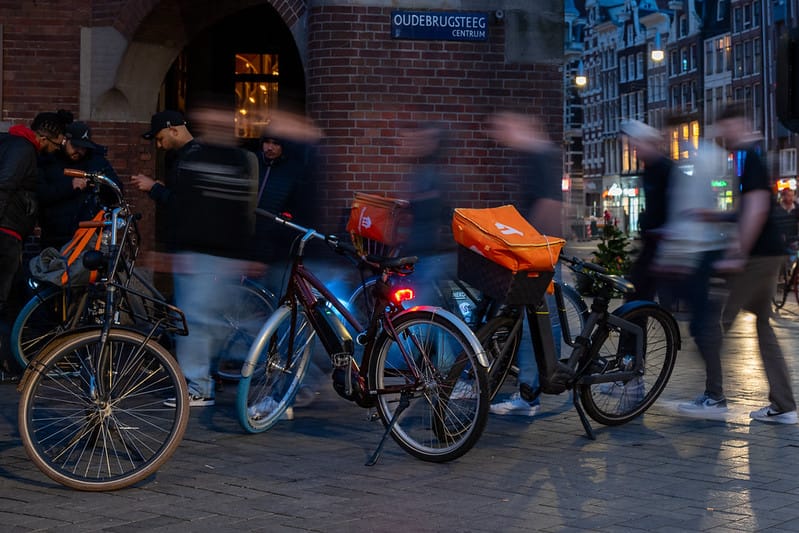
Delivery riders in Amsterdam, the Netherlands. Foto credit: Martijn Arets
The biggest lesson here is that individual agreements with a platform company are fine, but that sector-wide regulation is ultimately needed. If one player introduces higher standards whilst competitors do not, a competitive disadvantage arises. Or as Jack says: “It is not individual companies that should ‘set a good example’; the market floor needs to be raised.”
How the new system works
As Alex Veen, who monitors platform work across several countries, emphasises in this webinar, it is important to recognise that this case study takes place within a specific context. In the Australian system, trade unions negotiate minimum standards with companies, which are assessed by the Fair Work Commission. These standards are then imposed across the sector. This is a process that involves consultation between trade unions, platforms and other stakeholders.
It is interesting to note that the system explicitly considers multiple interests simultaneously: worker safety, fair pay, business sustainability and sector stability. This last element is rarely seen in European discussions. There, platform work is often framed as a conflict between innovation and protection. The Australian approach, is based on a different premise: a market without minimum standards is ultimately bad for businesses too. It is important to note that here too, the situation is more complex than it first appears.
Delivery rider in Jogyakarta, Indonesia. Foto credit: Martijn Arets
What do the minimum standards entail?
The initial proposals focus on the food delivery (Uber Eats and DoorDash), last-mile delivery (Amazon Flex) and taxi (Uber) sectors. Although each sector has its own set of minimum standards, the proposals generally concern minimum rates, transparency and representation. With regard to minimum rates, consideration is given to, amongst other things, compensation for work-related costs and insurance. The trade union has extensive experience in calculating minimum rates for self-employed workers.
Transparency is enforced by mandating transparency regarding pricing and algorithms, which should, amongst other things, lead to protection against unfair deactivations of workers. Representation is a comprehensive package, comprising, amongst other things, dispute resolution procedures, consultation rights, rights for worker delegates and access for trade unions to workers. Regarding representation, the trade union appears to have combined the concept of the German Crowdsourcing Code with Article 20 of the Platform Work Directive, whereby platforms are obliged to facilitate a communication channel between workers through which workers’ representatives must also be able to reach the workers. This may sound minor, but in a fragmented platform market, access between and to workers is a crucial factor of power.
The debate on waiting time remains complex
Discussions regarding the calculation of minimum rates primarily concern working time. For now, the Australian agreements only compensate for ‘engaged time’: the period from acceptance of an assignment to its completion. Waiting time is not compensated for under the minimum standards, which means that platforms have no incentive to prevent too many workers from accessing the platform at the same time. After all, even after the introduction of the standards, the cost of waiting time remains with the individual worker.
Delivery rider in Oxford, UK. Foto credit: Martijn Arets
Boutros is realistic on this point: under the current minimum standards, the income of platform workers – which, prior to the introduction of platforms, stood at half the Australian minimum wage – has risen by 20 to 30 per cent. He realises that a ‘fair’ minimum rate, such as that calculated using the WageIndicator Foundation’s Living Tariff, is still a long way off. The standards are therefore a first step and certainly not an end point.
To conclude
Although it is important to realise that the Australian case must primarily be viewed within the Australian context and cannot be copied one-to-one to other countries, there are still plenty of lessons to be learnt from this case.
The focus on job classification makes sense, particularly in Global North countries, but it is also wise to look beyond this. This is especially true in markets where a sectoral approach is necessary;
Improving conditions for platform workers takes time, as does building up a base of platform workers to represent;
A diverse approach, such as that in Australia, shows that you can play on several fronts at once;
Non-binding agreements are all good, but ultimately agreements must be sector-specific and legally enforceable;
Minimum standards work best when they are contract-neutral; this prevents platform companies from selectively shopping around to evade their responsibilities.
What particularly stuck with me from the conversation with Alex Veen and Jack Boutros is that the debate on platform work is ultimately not a technological or legal debate, but primarily a debate about power and counter-power. Who sets the terms, who bears the risks, who has access to information, and who can negotiate collectively? And thinking about institutional alignment and complementarities: how do you harness the technological innovation while addressing the externalities
In this case, certainly not all the answers have been found yet, and the current standards are far from perfect. But the union has done something that has barely been achieved in many other countries: shifting the debate from legal definitions to the fundamental question of how a sector can be organised sustainably. And perhaps that is precisely the most important lesson.
Lena Simet (Human Rights Watch) on platform work: From turbo-capitalism to just working conditions
In The Gig Work Podcast by the WageIndicator Foundation, Martijn Arets talks to Lena Simet from Human Rights Watch about the downsides of platform work and ways to develop effective policy. “Technology for organizing work has developed at lightning speed, but legislation to protect workers’ rights on platforms is hopelessly behind.”
How can we ensure that platform companies in the gig economy behave as responsible employers and clients, rather than greedy intermediaries who make ever-increasing profits and pass the risks and costs of doing business on to workers? Trade unions, labor organizations, and governments around the world are looking for a solution to this problem.
This includes Human Rights Watch, an international organization that investigates human rights violations worldwide. In recent years, senior economic justice advisor Lena Simet has been specifically studying the rights impact and economic fairness of platform companies on workers. I spoke to her about her research on The Gig Work Podcast by the WageIndicator Foundation. Her conclusions provide a good overview of developments and opportunities from a global perspective.
Legal vacuum
Simet studied the impact of taxi, food delivery, and grocery shopping apps on platform workers in Lebanon, Texas, and New York, among other places. “Technology for organizing work has developed rapidly, but legislation to protect workers’s rights on platforms is desperately lagging behind,” she says. “It’s a legal vacuum: platform workers are not formally employed, so the work and earnings are their own responsibility. Almost all the labor rights that have been fought for in the past seem to be non-existent in this business model.”
She thinks this is unfair. Her interest in platform work arose during the coronavirus crisis. “Platform workers were the heroes: they took to the streets to deliver meals or groceries, they worked in healthcare,” she says. “Everyone was happy with them, but that appreciation was not reflected in their working conditions. Many were not given face masks or hand sanitizers, and if they fell ill themselves, they received no compensation or paid leave.”
‘Working without protection should not become the new norm’
Meanwhile, the reach of platform work is growing enormously. “Platform workers are no longer just taxi drivers or food delivery workers,” she says. “Now you also see nurses, teachers, and therapists being hired on demand via apps. Instead of a permanent contract with fixed shifts, they are now deployed ‘on demand’ with varying hours and earnings.”
An increasing proportion of the global workforce is being hired and fired via platforms, she says. “This increases inequality in the labour market enormously. Our research shows that they have no protection under labor law. That is why new policy is so important. We cannot allow underpayment and lack of protection to become the new norm in the labour market.”
Employee or self-employed: decent work for everyone
Governments around the world are struggling with the legal status of platform workers: are they employees or self-employed workers? Being employed solves a lot of issues: often, job security and protections for employees are legally linked to this type of contract, but in practice, this is difficult to enforce.
In the Netherlands, too, the discussion is far from over. Just look at the latest ruling by the Amsterdam Court of Appeal on whether Uber drivers are formally employed or not. Conclusion: it varies from driver to driver. And in continents such as Asia, Africa, or Latin America, it is not at all common to have an employment contract. In fact, almost half (46%) of the global workforce are self-employed (ILO 2025).
That is why it is perhaps even more important at this point to find an answer to the question: how do we ensure that the risks and costs of self-employed people are covered just as well as those of employees? The biggest problems arise because platforms pass on the costs and risks that are borne by the employer in an employee relationship to the individual.
Platforms weaken individual bargaining power
Human Rights Watch’s research shows that action is needed. “We are seeing the consequences of a lack of regulation worldwide,” says Simet. “It is true that professional groups such as cleaners, taxi drivers, and food delivery workers did not usually work as employees even before the advent of platforms. But what has deteriorated is their bargaining power.”
She cites motorcycle taxis in Kenya as an example. “In the past, drivers set their own prices in negotiations with customers. Now, the app determines the price. Drivers no longer have any influence over this, especially since these companies often form monopolies.”
At the same time, platformization offers hope for improvement. “Platforms make workers who were previously invisible visible. If we succeed in forcing these large companies to pay workers decent wages, it will be a huge opportunity to provide millions of workers worldwide with better living standards.”
Lebanon: strong growth since 2019
When I spoke to Simet, she had just returned from Lebanon, where she had been studying the situation of platform workers. To her surprise, there had been hardly any research into the platform economy, even though the business model is growing rapidly there. “Since the economic crisis in 2019, platform work has been the only source of income for many people,” she says. “The group of workers is extremely diverse in terms of age, education level, and occupation.”
What are the consequences of platformization? Four concerning issues stood out to her:
Decline in income over time: She spoke to many people who have been working via platforms for a long time, sometimes as long as ten years. During that time, their income has usually declined. Many now receive only a fifth of what they used to earn. This is because there are now many more platform workers. Although prices for customers are rising, the platforms have the freedom to reduce the earnings of workers.
Lack of social security: Workers have to bear all costs themselves, have no sick leave, and receive no assistance in the event of accidents at work.
The huge gap between workers and companies: Companies are not interested in complaints. Workers can hardly unite to exert pressure.
Complete lack of policy. Platform work is not covered at all by current labor legislation.
Traumatic robbery
In the podcast, Simet tells the moving story of 74-year-old taxi driver Abraham. During the crisis, he lost his job, his savings, and his pension. Because of his age, most companies would not hire him, so in 2015 he started working via a taxi app.
One day, while driving, he was robbed at knifepoint by customers. They stole his phone and his car. He sought help from the platform company, but they refused to help him. After all, his contract stated that he was an “independent contractor” (self-employed), so he was entirely responsible for himself. “He was left traumatized and without a car,” says Simet. “With financial help from his family he was able to get by and eventually was gifted a car by his brother, who also helped him. He is working again, but he is still afraid every day.”
According to Simet, this story illustrates how platforms deliberately shift all costs and risks to workers with their business model. “Responsibility and humanity are lacking.” This is despite the fact that platforms, which operate in fragmented markets, could use economies of scale to improve conditions and mitigate risks. Not doing so is a conscious decision and strategy.
Exploitation in Texas
Research is the basis for creating policies around decent working conditions. What minimum protection do platform workers need? What is a Living Wage? Since platform workers are not employed, do not have fixed hours, and must arrange their own resources and security, such a tariff is structured very differently from an employee’s wage. Read more about a Living Tariff in this blog.
“It was very difficult to obtain data because companies are not required to share information about workers who are not employed,” she says. “So we collected information from the platform workers themselves. Initially, we saw a gross hourly wage of $16.90. But that is not what they actually earn from their work.”
Because platform workers have to pay for their own vehicle, phone, and internet, they are left with only $7.53.
If you then deduct the non-wage benefits that a normal employee would receive, you end up with $5.12 per hour. “That’s well below the minimum wage of $7.25 and even further below the living tariff,” says Simet. It’s important to realize that the minimum wage in Texas is not enough to live on. According to WageIndicator data, the Living Wage in Texas is currently $16.49. And keep in mind that the reported income per worker is an average. There are platform workers who, on days with high expenses and few rides, are left with virtually nothing, the big problem being that workers have no influence on the demand for work and the number of workers active on a platform.
Heartbreaking turbo-capitalism
“I found it heartbreaking to hear platform workers blame themselves for earning so little,” says Simet. “An older woman who shopped groceries for Instacart said, ‘Well, I just can’t walk fast enough.’”
She calls it capitalism on steroids. “A person’s value and income are determined solely by how quickly profit can be squeezed out of their labor,” she says. “It has nothing to do with fair compensation and creates perverse incentives that force people to risk their health.”
New York: collective action leads to fairer pay
Fortunately, Simet also sees progress. For example, app delivery workers in New York have succeeded in enforcing a minimum tariff. “It’s a wonderful example of how collective action leads to change,” she says. “The platform workers first conducted their own research to highlight the problems and presented this to the city council. The council’s own research confirmed their findings based on their own research: from extremely low pay to lack of safety and privacy violations.”
New York used this research as the basis for policy reforms. The municipality did not force companies to hire people as employees, but set a minimum tariff for platform workers to compensate for their lack of protection. Despite fierce opposition from platform companies, New York gradually introduced a minimum wage for platform workers.
Discussion about waiting time
There was considerable debate about that tariff. Platform companies argued that they cannot pay for waiting time because workers “have multiple apps open at the same time” and are therefore paid by three different platforms simultaneously.
“In reality, this ‘multi-apping’ is hugely overestimated,” says Simet. “About 80 to 90 percent of platform workers use only one app at a time. What’s more, these companies have access to all the data: they can calculate down to the second who is available when. In New York, this has now been resolved: companies must pay for the entire time that workers are connected to the app, including waiting time.”
More efficient and fairer
The result? Because platforms are now responsible for waiting time themselves, they have started to plan more efficiently. Since the introduction of the minimum rate in New York, the number of deliveries per hour has risen from 1.6 to 2.5. By placing the responsibility with the platform, the app has a direct incentive to use the worker’s time more efficiently.
The conditions for platform workers have improved enormously, says Simet. The city council is now looking at next steps, such as protecting platform workers who are banned from a platform for unclear reasons.
Global problem, global solution?
It is clear that the excesses of the platform economy are a global problem. Although local solutions are now being devised, the International Labor Organization (ILO) is working on a global solution. In June 2026, during the 114th International Labor Conference in Geneva, governments, employers, and employee organizations will work on finalizing the ILO Platform Work Convention. Lena is participating in this process on behalf of Human Rights Watch, and provided written input on a draft of the convention.
In Geneva, global agreements will be made on platform work, with a focus on social security, transparent algorithms, and the prevention of misclassification. I will also try to attend this conference to report on these negotiations. Whatever the outcome, I believe it is already a significant achievement that governments recognize the importance of this issue and that, contrary to many people’s expectations, we have succeeded in putting it on the global agenda. After all, fair working conditions are the responsibility of us all.
In the discussion about platform work, I keep bumping into a big dilemma. Online platforms offer a fast -access solution for work and income in the short term. At the same time, they often fall short in providing good working conditions, sustainable careers, and future perspectives. In my opinion, this tension is the most important challenge for the future of work. How do we solve it?
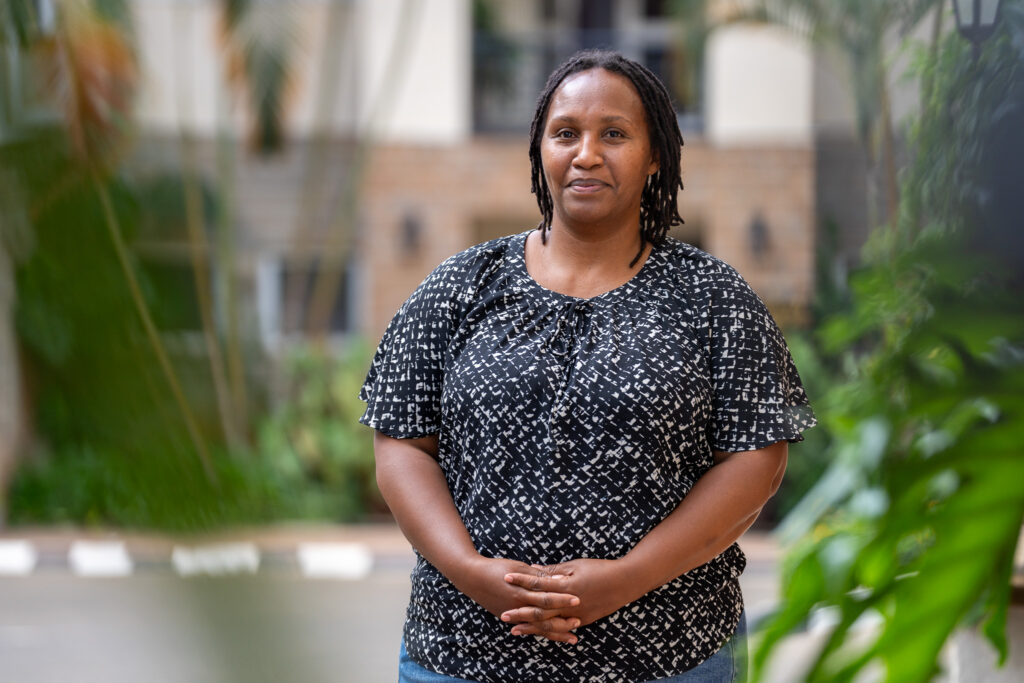
Frida Mwangi knows all about it. She made the transition from housewife to platform worker, and then went on to become an entrepreneur and union leader. As a founding member of the Kenya Union of Gig Workers (KUGWO), she champions the rights of Kenyan platform workers. Her lessons are relevant not only for Kenya, but for the platform economy worldwide. I spoke to her for a new episode of The Gig Work Podcast by the WageIndicator Foundation during my visit to Nairobi, Kenya.
A new start
Mwangi knows from her own experience what opportunities and perils the platform economy can offer. After being a full-time motherand housewife for 17 years, she wanted to return to work. Not only to earn money, but also to set an example for her children. But without recent work experience or references, a regular job was out of reach.
Then she discovered Upwork, one of the largest international platforms for freelance work. After a short training course, she was able to start working right away. Her first job was converting audio into text (transcription). “I could work from home in my own time, which was ideal in combination with raising my children and running the household,” she says. “In the beginning, it was exhausting because it was my very first job. At the same time, it felt like confirmation: ‘Oh, this is real. And it’s something I can actually do.’ It felt like a chance for a new life.”
Learning from others
Mwangi once wanted to become a lawyer, but that didn’t happen. She was still eager to learn. She discovered all kinds of online communities where platform workers shared knowledge and experience. “I learned a lot from that, both about the work and about how to earn more,” she says. “Those communities were incredibly valuable. In no time, I had more work than I could handle. I was able to outsource my surplus work through my own small business: Kazi Remote.”
This shows that platform work can be a stepping stone to employment and self-employment. But Mwangi also quickly discovered the negative aspects.
Frida Mwangi, foto door Martijn Arets
Unilateral conditions
Firstly, working conditions and earnings could change suddenly. Initially, she earned between $15 and $20 per assignment, later rising to $100 when she specialised in legal, financial and academic transcription transcription assignments. “As more people started working via Upwork, it became more difficult to get jobs,” she says. “The problem was that you had to bid on assignments, and that system was unreliable. Some days you kept bidding without getting any work.” The work also shifted from transcribing to proofreading AI-generated transcriptions.
Then Upwork introduced a new system. Platform workers had to buy credits to bid on a job. “To maintain a secure position on the platform, you sometimes have to spend up to $45 a month on credits,” says Mwangi. “For those coming from a financially vulnerable situation, that’s a significant barrier. The platform suddenly made the workers bear all the risks.”
Exclusion and slow payments
What’s more, the algorithm could exclude you for no reason. “Sometimes you would wake up and find that your account had been blocked without warning,” she says. “Often you would be reinstated automatically, but that took a while. In the meantime, you lost income.”
Platforms did not take responsibility, she says. ‘In the beginning, PayPal was not accessible to the African region. When the service did become available, accounts were regularly closed, even though the workers’ money was still in them. And payments were sometimes delayed by months. When we had complaints, no one was available to help us.’
Internet waste and mental damage
Ironically, Frida’s activism began through an initiative of the platform itself. During an Upwork event, she met other freelancers and discovered that she wasn’t the only one with problems. She also heard dire stories from colleagues in content moderation and data labeling. This is the work where people have to remove illegal or offensive texts or videos from platforms and train algorithms to recognize this type of content.
“Many thought they were going to do translation work, but instead had to filter harmful content on a daily basis,” she says. “It was garbage, internet garbage that you had to sift through. And the more you take in, the more harmful it is to your mental health.”
‘Platforms don’t offer a career’
She also saw that while platforms offered a stepping stone to work, they didn’t really help workers progress. “If I had stayed stuck in my transcription work, I would hardly have any assignments now,” she says. “This type of work has now been largely automated. That applies to more jobs via platforms.”
Tech companies offer a low barrier to entering the workforce, but rarely offer opportunities for advancement, training, or guidance. Mwangi: “I realized that platforms don’t offer you a career, but are only suitable as a temporary place to earn money. Yet many people become dependent on them, precisely because of the lack of opportunities for advancement.”
Organized action is not easy
She also heard more and more stories about underpayment in location-based work, such as taxi services. All these stories touched her deeply and brought back an old dream: to become a lawyer. She felt a strong urge to stand up for platform workers. Mwangi: “I believe that platforms must take responsibility, both in terms of working conditions and pay, as well as in terms of long-term prospects.”
Her first attempt to set up an association in 2019 failed. “No one had any experience with organizing,” she says. “Moreover, organizing is not easy in the platform economy. Whereas in a factory hall it is easy to talk to colleagues about problems, platform workers sit alone at home. There is also a gap between the different types of work. Online freelancers feel different from Uber drivers, for example.”
But she did not give up, because she was convinced that collective action was necessary. In 2024, she succeeded: together with other platform workers, they founded the Kenya Union of Gig Workers (KUGWO). It is the first Kenyan trade union dedicated to improving working conditions, wages, and rights for all types of platform workers.
‘It’s a matter of taking responsibility
Mwangi’s vision: platforms can offer both short- and long-term benefits for workers. “It’s a choice for companies whether or not to participate in exploitation,” she says. “That doesn’t just apply to the platforms themselves. Their customers are often large Western corporations. These companies must not forget the ‘S’ (Social) in the ESG principles (Environmental, Social, and Governance).”
KUGWO is keen to work with tech companies to put the interests of workers first. A good example is the collaboration with Microsoft/LinkedIn Learning. The Kenyan union pointed out that platform workers who lost their jobs due to automation had no opportunities to improve their skills. After consultation, Microsoft offered eleven free courses (such as project manager or software developer) as a stepping stone to better work. Mwangi: “This proves that even in a complex relationship, you can find concrete and sustainable solutions.”
Frida Mwangi, foto door Martijn Arets
The power of strong unions
Finally, I spoke to Mwangi about political influence and regulation. According to her, the voice of workers in Kenya is systematically ignored by policymakers. Her appeal to the rest of the world is therefore clear: “Build stronger institutions that enable workers to exert more influence. Support them, for example with legal and technical expertise. Employers and governments already have so much power, while workers are in a weak position.”
Mwangi emphasizes that you need financial independence and a strong membership base to be able to negotiate at all. She knows from experience how difficult that is. Nevertheless, with her resilience and perseverance, she has already achieved a lot.
Finally: is it a dilemma?
Mwangi’s call echoes earlier conversations I had, such as with Ephantus Kanyugi of the Kenyan Data Labelers Association. This is not an official trade union, which is precisely why it is fast and flexible. Mwangi chose a different route: establishing a formal union, with all the bureaucracy and political dynamics that entails. In practice, they are complementary. They have different strategies but a shared goal: better working conditions and pay for platform workers.
I agree with Kanyugi and Mwangi: what is needed in the short term and what is important in the long term must go hand in hand. Quick and easy access to work, with security and future prospects. Especially when the clients are companies, they must take responsibility and not shift it onto individual workers. Clients and platforms must choose: do they contribute to exploitation, or do they help build prospects for workers worldwide?
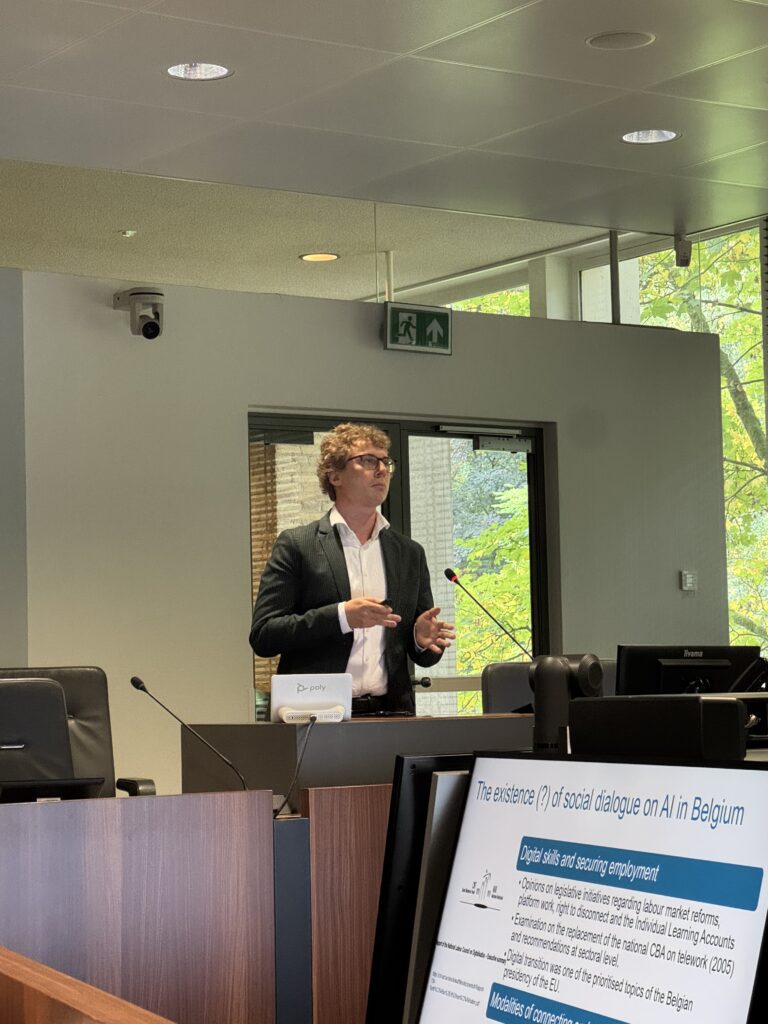
Last week, I had the opportunity to contribute to a seminar organised by the International Society for Labour and Social Security Law in collaboration with the Levenbach Institute. The theme was “The role of social partners in the use of AI at work”. Following contributions about experiences in the Netherlands, Belgium and Europe, I was asked to conclude with some reflections and to lead a workshop. Here are a few takeaways and thoughts:
The impact of technology on labour is not new; we can learn a lot (as previous speakers mentioned) by looking at past experiences.
AI and work is often not about replacement, but about the quality of – and access to – work and a growing asymmetry of power between employers/clients and workers.
Social partners fill the gap between regulation and society, but I wonder whether the pressure becomes too high when enforcement is lacking, and the question is what skills social partners lack in order to be an equal partner in the debate;
At the same time, social partners can really make a difference by including agreements on AI (I know: a very broad concept) in collective agreements. The only disadvantage of this is that 1) collective agreements usually apply to employees, while 46% of the working population worldwide is not employed, 2) collective agreements are often (especially when viewed globally) not public, which means that unions and sectors cannot learn from each other effectively, and 3) if you look at worker protests in the gig economy (= the testing ground for AI and labour), grassroots movements are by far the largest organisers, not trade unions.
In discussions about labour law, preference is often given to employee status, while in many cases this will result in working with subcontractors and temporary employment agencies. Yet another company taking a slice of the pie, and you know where the bill will end up. I still miss a broader discussion about the value and appreciation of work.
We really need to think about contract-neutral regulations and protection. See, for example, this paper on the European Platform Work Directive.
Discussions about AI and work tend to focus on those who use AI or where AI is applied, but not on the workers and the work in the AI supply chain.
After my introduction and reflection, the attendees divided into groups to discuss the following four issues I had brought up:
Which stakeholder is responsible for setting up and managing a data wallet for workers: the GigCV case study.
How can the cooperative model leverage power in the topic of work and AI for workers?
How can we create a tariff floor for self-employed workers?
How can social partners safeguard the rights of workers in the AI supply chain in a global labour market?
All in all, it was an interesting session to attend and contribute to, and it is always great to learn more from other disciplines. Thank you to Miriam Kullmann and Matthijs van Schadewijk for the invitation and organisation, and to Mijke Houwerzijl, Juliana Londono, Simon Taes and Klara Boonstra for your inspiring presentations.
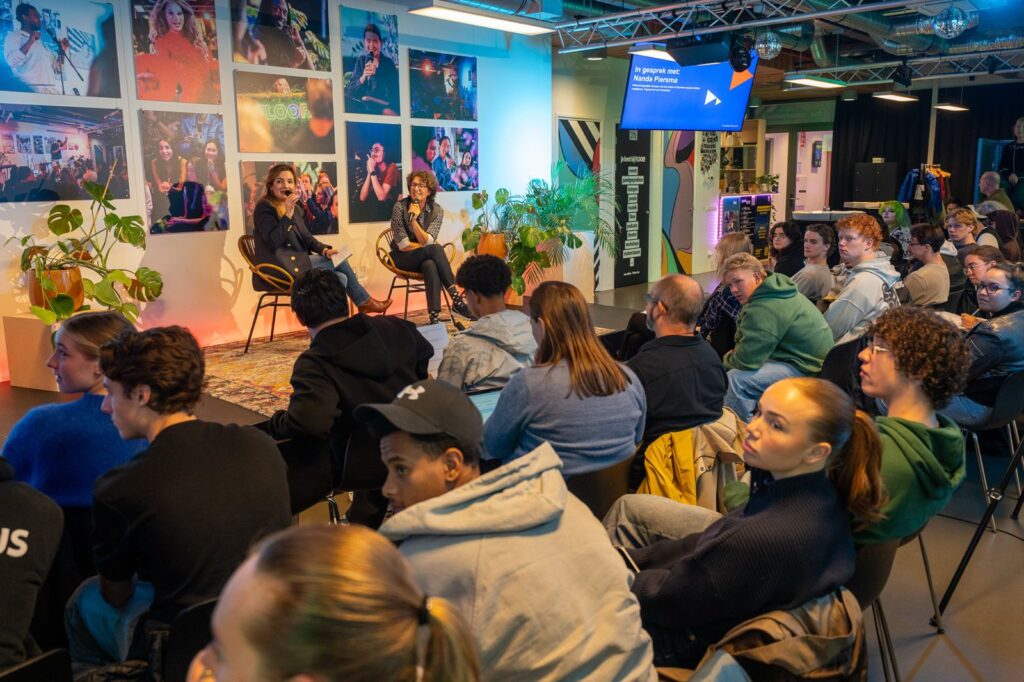
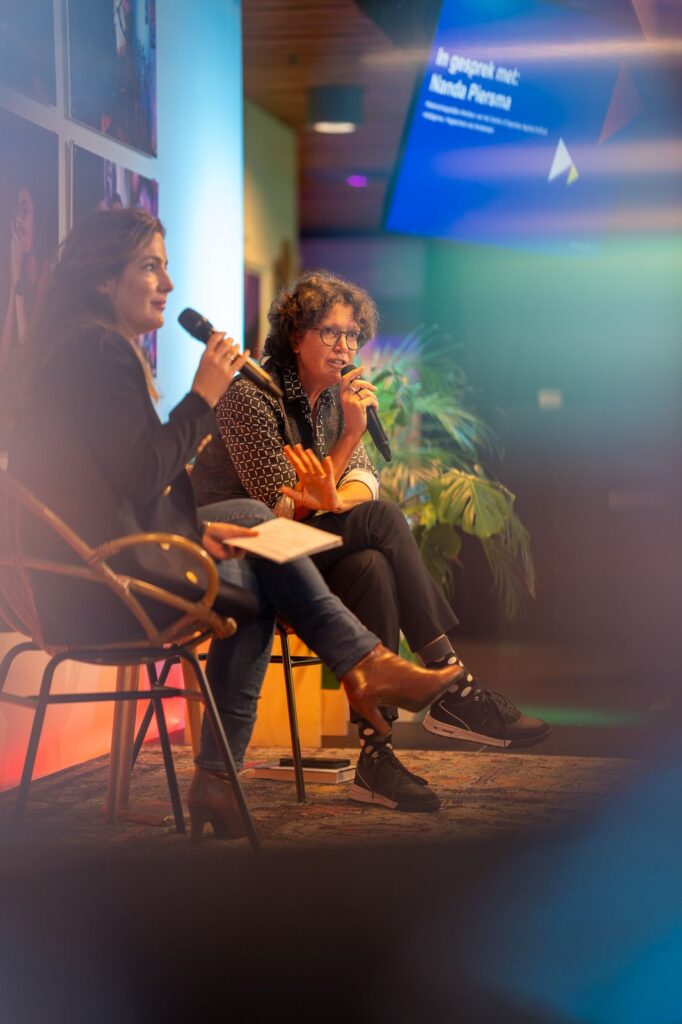
Last week, together with Tessa Duzee, I organised the event “Ghostwork, the invisible labour behind AI” at the Amsterdam University of Applied Sciences. The aim was to raise awareness of the fact that behind AI there are tens of millions of vulnerable workers who annotate and check the data, thereby keeping AI running. And to start a conversation about how we can improve these working conditions. From the perspective of the individual, from professionals in “Responsible AI”, from the Amsterdam University of Applied Sciences itself and from organisations (AI companies and their customers). This was led by moderator Tessa and contributions from experts Fiona Dragstra (WageIndicator Foundation), Nanda Piersma and myself. The data workers themselves were also given a platform through video clips, where they talked about their experiences.
It was interesting to bring together the various disciplines and engage in open discussion with the 80 students in the room. My five takeaways from this event:
Whether or not to exploit workers is a conscious choice. Not exploiting them is also a choice. The data work market is characterised as a to-business market, which is different from other gig markets such as taxi and delivery. And in a to-business market, organisations are responsible for their supply chain. I am looking here at both the AI companies themselves and the customers they serve.
In a market where organisations capitalise on fragmentation and information asymmetry, bringing people together is more important than ever. Think of trade unions and cooperatives. The key to solutions or resistance lies in finding and connecting nodes with which you can create critical mass. Consider, for example, (Dutch) organisations such as SURF and Public Spaces. But the government, as (I suspect) the largest customer of big tech and a major distributor of capital through subsidies, is also such a node. Make use of this, take responsibility and dare to make choices.
Creating fair(er) alternatives takes time. It is not realistic to expect alternatives to be as smooth and scalable to use as the current dominant players from day one. After all, they have a head start of years of innovation, learning and further development. Paid for from the income we as users have paid. Breaking this cycle requires us to bite the bullet, where short-term convenience and long-term sovereignty are at conflict with each other.
There is a lot of talk about European “champions”. Of course, I am in favour of European tech companies, but as long as nothing changes in terms of ownership and governance, there is nothing to prevent these companies from eventually being bought out by other parties or making profit-driven choices that have a negative impact on society themselves. That is why I advocate, in addition to “home-grown” tech companies, also engaging in dialogue about ownership and governance and making models such as the Steward Ownership model more common and financing for these types of models more attractive.
The biggest question during the event was: “What can you do as an individual?”. Firstly, I don’t think you can place the responsibility on the individual. But that doesn’t mean that you can’t do anything as an individual. Make conscious decisions, engage in conversation, listen critically to cheering stories (and keep in mind the interest of the sender of a message) and contribute to highlighting and addressing the issues that matter.
All in all, it was a great meeting, and I hope it has contributed to a better-informed debate about (responsible) AI among students, professionals and the AUAS itself.
Last week, the 8th conference of the ‘International Network of Digital Labor’ took place in Bologna. This network’s mission is to research and discuss aspects of work in the digital age. I traveled to Bologna by train to attend the conference and present my research on GigCV and data portability for platform workers, which I am conducting at the Amsterdam University of Applied Sciences. During the conference, there was a lot of talk about data work(ers), the gig economy, and a broader discussion about the impact of technology on work. In this blog, I share my insights and thoughts. In my story, I choose to focus on data work and the labor behind AI. Because this issue brings together all the challenges of an imbalance of power in the world of technology, especially from the perspective of the “Big Tech” platforms and mentality.
Technology has a growing impact on how we find, perform, distribute, control, evaluate, and value work. Not only at the individual level or within the silo of an organization, but also from a geopolitical perspective. The impact on individual workers is often discussed in the (on-site and online) gig economy, but is also clearly visible in the (digital) workplace. In recent years, the development of—and discussion about—AI has been added to this. AI is not a separate silo, but a technological development within the automation of work. And it always takes place within a specific context.
How platforms are fragmenting markets
The platform model works well in fragmented markets where the costs for different stakeholders (often: supply and demand) to find each other are high. In short: markets with a high degree of information asymmetry. The promise of platforms is that, as a ‘digital message board’, they will bring clarity to markets such as (social) media, e-commerce, the sharing economy, or the labour market. As the center of the network, they have an overview and, via digital technology, they can facilitate the matching of stakeholders, create trust, and execute transactions.
The paragraph above is how I used to view this, but nowadays I am more critical. Or perhaps I should say: more realistic. I am still convinced that platforms operate in fragmented markets, but I see an important nuance in that platforms have an interest in these markets becoming and remaining more fragmented and in the number of competitors with an equal information position being as small as possible.
In the beginning, Uber broke down local taxi markets by selling services below the price of cost and being “creative/selective” in interpreting regulations. Not only to ‘capture’ market share, but also to fragment the supply in the local market and thereby strengthen its own position. A new interpretation of “divide and conquer.”
Gig workers in Bologna waiting for their next gig
Looking back on the past 20 years, social media platforms have also fragmented the ‘market’ for social contact and the business-to-consumer market by first facilitating users with the platform and then reducing the possibilities of owning your own network. For example, my business network has slowly but surely become dependent on my contact list on LinkedIn, but the function to export this list (including contact details) suddenly disappeared. Projects or jobs are also broken down into tasks. Sometimes this is much more efficient, but it is also a way of increasing the information position and thus the company’s interests. Finally, consider platforms such as Booking, which do everything they can to maintain information asymmetry and make use of data on demand (reviews) and supply (advertisements).
In addition to local and national fragmentation, international fragmentation is also being exploited. Or perhaps better said: the use of institutional fragmentation. International regulations are absent, allowing platform and technology companies not only to pit countries and continents against each other, but also to “shop” for countries that do not ask too many questions or that have a poorly developed institutional landscape.
The result is a growing concentration of power, the increasing externalization of risks and costs to individuals and society, and increased dependence (and decreased sovereignty).
Data work
One field in which fragmentation is evident in all the areas mentioned is data work. This is the work that forms the basis of the AI we all use. Think of annotation, moderation, checking, and updating. This is a topic that came up frequently during the conference and one that I have been working on a lot lately, as you can read and listen to in the latest podcasts I made for the WageIndicator Foundation.
During the conference, the documentary “In The Belly of AI” was shown, which paints a dystopian picture of the conditions under which at least 150,000,000 data workers have to do their work. Not as an unfortunate side effect, but as a deliberate strategy.
The trailer for the important and impressive documentary “In the Belly of AI.”
In Bologna, several data workers were presenting, and I spoke to some of them. Their stories are intense. People who are so changed by their work that those around them no longer recognize them. They are regularly diagnosed with PTSD, and even years after they have stopped doing this work, they still have symptoms such as insomnia, nightmares, and impaired short-term memory.
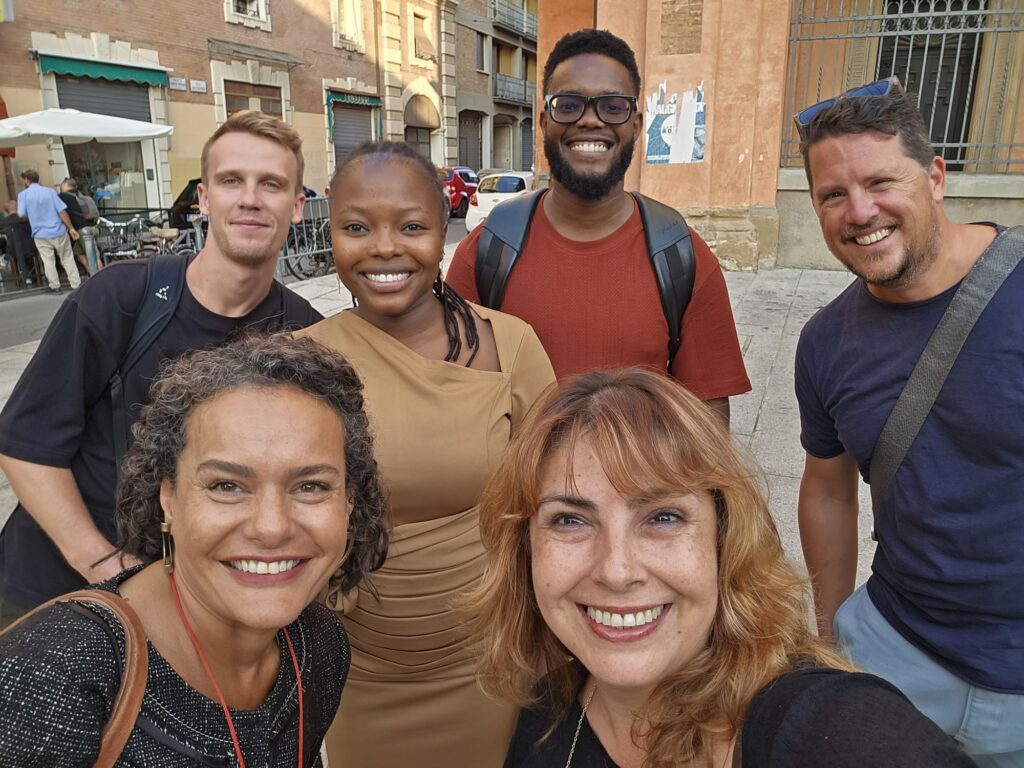
Taking a picture with, among others, various representatives of data workers and content moderators.
Colonial structures and concentration of power: from Big Tobacco to Big Tech
The second day took place at DAMA, where the site of a former tobacco factory now houses an ecosystem of initiatives related to AI and data. A public initiative. Although DAMA is a public initiative, the fact that it is located in a former tobacco factory is an interesting choice. You could say that both sectors, tobacco and Big Tech, have many similarities. Think of having a powerful lobby, a prime example of ‘using’ colonial structures (read: exploitation) and externalizing costs and risks to the individual and society.
The dilemma is that the impact of the tobacco industry is essentially bad and should be minimized, whereas AI, if used under the right conditions, also has many positive aspects. I would like to note, however, that if a fair price were paid for AI, many services such as ChatGPT would be available to far fewer people or, at the very least, would be used much more consciously. Which in itself would not be a bad thing. In addition, discouraging smoking through policy and individual efforts is easier than stopping AI. I am therefore not in favor of stopping AI, but I am in favor of AI that does not adopt and reinforce existing power structures. Perhaps it is naive to believe that things can be different, but ultimately everything is a choice, and making choices involves taking responsibility.
AI: good for whom?
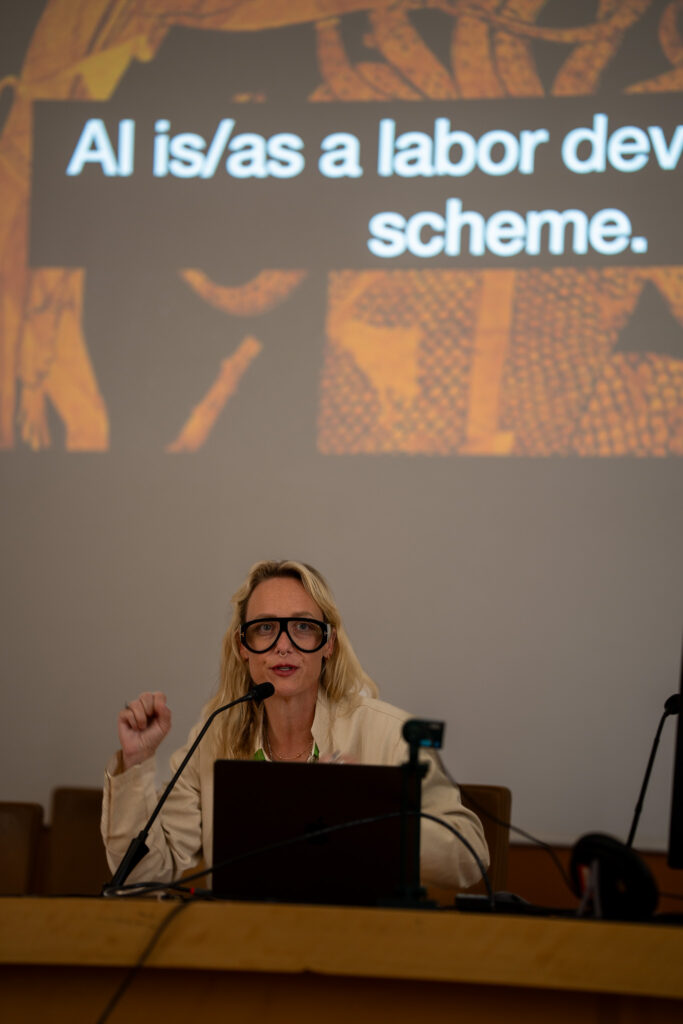
AI gives more people access to more opportunities. More people, but by no means all people. Sarah Roberts, professor at UCLA (University of California) and author of the book ‘Behind the Screen: Content Moderation in the Shadows of Social Media’, has a clear opinion about who AI is really good for. In her presentation, she called AI a ‘systematic mechanism for labor devaluation’. She asked the (legitimate) question: who benefits from AI? Of course, individual users reap the rewards of AI, even though they are now, in a sense, data workers, training a system that skims off the value.
Sarah Roberts, professor at UCLA (University of California) during her contribution in Bologna
To know who the real winner is, it is important to look at where the profits made with AI go. For example, AI allows workers to work more efficiently, but this will generally lead to an employer or client demanding more work from the worker in the same amount of time. This can be seen, for example, at translation agencies, but also in distribution centers, as can be read in the “Fairwork Amazon Report 2024: Transformation of the Warehouse Sector through AI.” This does not only apply to low-valued and low-paid precarious work. Because let’s be honest: would your boss allow you to spend the time you save by being more productive on vacation days for the same salary?
As I wrote earlier, I am not opposed to AI or technology. I too see the possibilities that exist and enjoy the benefits of these developments every day. What I am opposed to is the inequality that is increasing as a result of technology, the impact of these large companies on the debate and policy, and the way in which costs and risks are externalized and profits are privatized (at all costs).
Where are the solutions? Although there is no “golden bullet” that can fix everything, I believe it starts with acknowledging and recognizing the situation. Looking beyond the industry’s rhetoric and asking critical questions. To begin with, there is a lot of talk about the impact of technology. In my opinion, it should be less about the technology and more about the underlying choices, ownership, and governance structures. Technology in itself does nothing; it is the choices made by the stakeholders involved that determine its effects. The advantage of this perspective is that you can no longer hide behind ‘not being able to understand’ systems because they are too complex. The system should never take center stage, and everyone, every stakeholder, is jointly responsible.
It is also important to recognize that tech companies are businesses, not countries with democratically elected representatives. So please stop talking about democratization, because giving a few more people access while simultaneously strengthening your own unelected power has little to do with democracy. In any case, I invite you to be more critical of the words used in the discussion. Be sharper, be more critical.
Back to data workers: where are the solutions here? The advantage of the market behind data work compared to the broader gig economy market is that the buyers of data work are almost always companies, while buyers in the gig economy are almost always consumers. The advantage of companies is that it is easier to address them and hold them accountable for the choices they make. In the clothing industry, exploitation in the production chain is being combated, and this can also be done in the AI supply chain. And again: the exploitation of data workers is not an incidental coincidence, but a very conscious choice. A choice made by companies valued at many billions of euros.
Many initiatives are bottom-up, and trade unions, whose core focus is on organizing workers and thereby reducing the power imbalance, are, in my opinion, still not looking enough at how they can support these workers with creative tools. For example, in Bologna, I attended a presentation by ‘Reversing.works’, which uses workers to investigate what data the worker’s platform stores, uses, and sells.
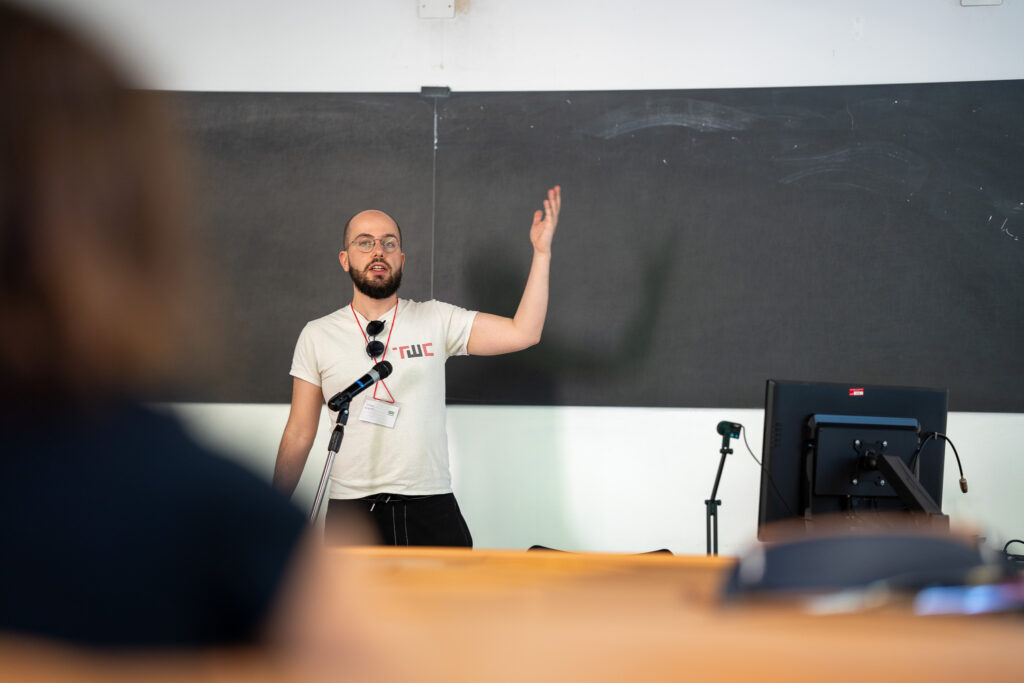
Simone Robutti from Reversing.works presented during the conference how they strengthen the information position of digital workers.
To conclude
I have said a lot in this blog, and it was sometimes challenging to keep it structured. I hope you can forgive me for that. The conference in Bologna was the trigger for writing this piece, which brings together a lot of the thinking I have done over the past few months and years.
If there is one thing I hope you will remember after reading this blog, it are three words: together, choices, and power. Together: I see too many silos in the debate, each with their own agenda and their own language, without much interest in delving into the other side. That is a shame: the only way to work towards a sustainable solution is by working together with all stakeholders. To understand why the other person does what they do. Just because you may not be able to identify with another stakeholder does not mean you should close the door. My tactic is to try not to get annoyed, but to be curious. That has helped me a lot. By being curious, however difficult it may sometimes be, you remain open-minded and keep the door open.
Choices to emphasize that everything we do is the result of decisions that are made. And decisions can be influenced. When you are aware that choices can and must be made, you are also aware of your responsibility in this regard. And finally: power. Ultimately, it is important to look beyond all the beautiful stories and cool tools and see what a development contributes to gaining or losing power. By simply asking the question: why does someone say what they say and who wins when this becomes reality? Which boils down to the advice to remain critical, without becoming bitter. A daunting task in this day and age, but nothing is impossible.
Rollee makes it easier for platform workers to access financing. Until now, it has been difficult to obtain a loan without a steady monthly income. Lenders want a clear picture of income in order to calculate a credit score. Rollee unlocks data from platforms, banks, tax portals and other relevant data sources for lenders. This should lead to fair access to financial services for all workers, says founder Ali Hamriti in this episode of The Gig Work Podcast by the WageIndicator Foundation.
Outdated system
The idea came to Hamriti, who is Moroccan-French, when he was working at a fintech company in Paris that provides loans to small businesses and the self-employed. ‘I noticed how difficult it was for freelancers to provide financial institutions with enough certainty about their income to get a loan,’ he says. “The problem is that self-employed workers and platform workers are not employees and therefore do not receive monthly payslips. Their income varies from month to month. This makes it difficult for lenders such as banks to assess their creditworthiness, and they are often denied loans.‘
He knows that not having a payslip does not mean that they are not creditworthy. ’On the contrary: in Europe, you sometimes see that people can earn more as freelancers than in salaried employment, with more freedom,” says Hamriti. ‘Yet they are often excluded from financial services because the current systems are not organised for this. Bank statements show payments and income, but banks simply have too little context for that income. This inspired me to build a new system.’
Retrieving and sharing data
The basis of Rollee is a so-called API (Application Programming Interface): software that enables two applications to communicate with each other. ‘We link to alternative data sources about work, income and taxes,’ says Hamriti. ‘I discovered that you can get more contextual data via freelance platforms and tax portals, for example.’
The result is an open platform that allows workers to collect their platform data, income data, tax data, payslips and invoices, for example. Lenders can request and analyse all this alternative data on income and work via the API platform.
Insight into platform work
In the beginning, he focused mainly on platform workers. ‘They have more access to work via digital media, but not yet to financial services,’ he explains. ‘In emerging markets such as Africa and India, current platform workers were previously invisible to lenders because they worked informally. They found their customers through word of mouth, and payment was in cash.’
But now they are increasingly working via digital platforms such as Uber and Upwork. ‘That suddenly makes their work and income transparent,’ he says. ‘If they can share that overview with lenders, it opens up opportunities for financial services such as credit.’
100 integrations
‘Our goal is to give as many people as possible access to the financial system,’ says de Hamriti. “We started by focusing on platform workers, but it is also suitable for other workers with variable incomes. With Rollee, banks can make better-informed and fairer decisions about the creditworthiness of all types of workers. It is a solution for all kinds of financial service providers: from leasing companies and banks to insurers.”
Rollee works with all kinds of companies and agencies, such as the Tax Administration and banks. They now have more than 100 integrations with freelance platforms, tax portals, payment systems and digital wallets. No direct cooperation with platforms is required, see box.
How does Rollee work in practice?’
A platform worker who wants to take out a loan from a financial service provider that uses Rollee logs into the accounts he uses to perform gigs via the Rollee environment. This gives the system access to the platform accounts. Rollee can then retrieve information about work and payments. The lender can then use this data to calculate a credit score. ‘We offer a quick and easy way to integrate data,’ says the entrepreneur. ‘We have both API and no-code solutions, so even large companies can add our system quickly and easily.’ The Rollee team helps service providers determine which data they need to analyse for different types of workers. Hamriti emphasises that workers remain in control of their financial data. ‘You decide who can access your data.
Privacy and statistics
Rollee does not store any personal data, he explains. ‘We only facilitate the transfer of data between workers and lenders. When a worker links their bank account or platform data, the data is sent directly to the selected third party. After the transfer, we only store statistical data, such as average incomes per country.’
Rollee’s mission is to make the financial system fairer. That is why they do share statistics with financial service providers. ‘This enables us to help lenders better tailor their acceptance criteria to modern workers,’ says Hamriti. ‘For example, they can adjust their criteria if it turns out that freelancers with a slightly lower income are still financially stable.’
Hamriti is also looking to collaborate with modern lenders. ‘In the long term, we want to help workers find the best interest rates and financial terms via our fintech partners,’ he says. ‘Companies such as Revolut and Monzo can make competitive offers via our platform. This allows workers to get a fairer, better deal based on their actual income rather than general credit rules.’
International cooperation
Hamriti is currently focusing on Europe and the United States. Emerging markets such as Africa, Asia and Latin America are also very interesting for Rollee. ‘We have already helped companies in Nigeria and Kenya, where digital payments are often better developed than in Europe,’ he says. “We work with banks and lenders that operate in several countries. That makes sense, as freelancers in the platform economy often work across borders.‘
Rollee is also in dialogue with governments about regulations surrounding data sharing. Hamriti sees that France and the Netherlands, for example, are rapidly improving their digital services. ‘And there is a major European project to develop a digital identity card,’ he says. ‘This will make data exchange increasingly easier.
This offers opportunities for growth for our company. After all, financial institutions need a uniform, secure API to access different data sources. We can help with that.”
Rollee versus GigCV
What makes this conversation so interesting to me is that Rollee has both similarities and differences with my own initiative: GigCV. This is an API that allows platform workers from affiliated platforms to download an overview of their work experience in the gig economy. Via an open standard, they can easily obtain an overview of their reputation and transaction data on platforms.
The more platforms share their data, the more valuable such a CV becomes. That is why I am seeking cooperation with platform entrepreneurs. In practice, it remains difficult to convince enough parties of the strategic advantage of sharing data. Moreover, they have to integrate the GigCV API. Rollee takes a different approach. This initiative does not depend on the cooperation of the platforms, because they log in on behalf of the workers. This allows them to scale up much faster. In addition, the data is immediately usable: banks already use this information to calculate risks, but the problem was that they simply did not have access to it.
I predict that platform data and data portability will become increasingly important. Regulations such as the Digital Markets Act (DMA) and the European Platform Work Directive mean that data will no longer be shared only on request, but will be available immediately and in real time. Large platforms must give their users access to data and offer free tools for data exchange, such as APIs. This gives users more control and stimulates innovation. Article 9, paragraph 6 of the Platform Work Directive confirms this right within digital labour platforms. This is good news for the future of initiatives such as GigCV and Rollee, and therefore for platform workers.
What are the advantages, disadvantages and challenges of data work? Who are the people who annotate and correct the data behind AI (so-called “data workers” or “data labelers”)? In the previous two episodes of The Gig Work Podcast, I spoke with researchers Claartje ter Hoeven and Antonio Casilli about this topic. But if you really want to know what it’s like to train AI with data, it’s best to ask the workers themselves. That’s why I visited Ephantus Kanyugi (30) in Nairobi. He is a data labeller himself and a pioneer for the labour rights of his colleagues in Kenya.
From economics student to data labeller
Kanyugi had always been interested in working with computers, but he chose to study economics because he thought he would have better job prospects in the financial sector. However, after graduating in 2016, he was unable to find work. ‘There were very few job vacancies and I had no work experience or connections in the financial world.’
To make ends meet, he did simple jobs that paid little: selling clothes on the street and looking after animals. Until a friend told him about vacancies at CloudFactory. ‘You didn’t need any qualifications or experience, you just had to take a test to show that you could think analytically and were good with computers,’ says Kanyugi. “That’s how I got my first job in the AI sector as a data labeller.”
Working conditions at the office
The work was interesting, he says. He worked four-hour shifts, with simple tasks in the morning and a more challenging project in the afternoon. He had a lot of variety. Sometimes he worked with images, other times with geographical maps. But the working conditions were poor. Kanyugi worked on a contract basis and earned just enough to stay below the tax threshold. He earned around 20,000 Kenyan shillings per month (about 180 dollars), but his travel expenses alone were around 80 dollars.
‘There were two groups within the company: regular employees and freelancers,’ he says. ‘Regular employees received insurance, a pension, bonuses and maternity leave. As a freelancer, you were only paid for the hours you worked. If you were sick or on leave, you just had to hope there would still be a place for you afterwards.’
From office to working from home
In 2020, he discovered the Remotasks platform. Via this website, he could earn money from home doing data annotation. He created a profile on the platform and accepted all the terms and conditions. He thinks he was one of the first people in Kenya to do this.
In the beginning, he earned well: 10 to 20 dollars an hour. ‘To earn a decent wage, I worked eight hours at CloudFactory and then another eight hours for Remotasks,’ he says. ‘But I soon quit my job at CloudFactory because I earned a lot more working remotely.’
Significantly less paid
He now worked 16 hours for Remotasks. In the beginning, this provided him with a good salary, but the payment soon decreased. The more people started working via the platform, the less he earned per project.
‘While I used to earn 10 dollars an hour, I later worked three hours for just 2 dollars,’ he says. ‘In addition, the tasks became more complicated. What’s more, the company could also reject your work, even if one image was not annotated correctly or if you simply took too long. Then you didn’t get any money at all, not even for the hours you worked.’
All this meant a lot of unpaid labour. ‘I had to work more and more hours at the computer to make ends meet,’ he says. ‘It was exploitation, but I was so deep in it that I didn’t realise it. What’s more, there were other things that weren’t right.’
Human rights violation
An example is a client who promised him £10 for 12 photos or videos of smiling, playing children.
‘Later, they said that one of the 10 images was “no good”, so they didn’t pay you anything for the whole series,’ he says. ‘Afterwards, I realised that they were exploiting our work and also violating the privacy of children, without us even noticing.’
There were more privacy issues. For example, Kanyugi was monitored via tracking software and his webcam while working on his computer. He was required to turn it on during work. ‘I have no idea if the company stored those images and what happened to them,’ he says. ‘Furthermore, the images I had to classify were sometimes very disturbing. Some projects contained nude images or even images of deceased people.’
Data Labelers Association
But he only realised that his work situation was unlawful when he met researcher Berhan Taye from Stanford. With her “AI Harms” project, she is researching the adverse effects of the development of artificial intelligence. She wanted to know more about the working conditions of Kanyugi and the other data workers. Kanyugi: ‘We came to the conclusion that this way of working was a violation of our human rights.’
At the end of 2023, he and nine other data workers formed a collective to stand up for their rights. They wanted to start a trade union, but that proved difficult in Kenya. So, in early 2025, they founded an association: the Data Labelers Association
Strong growth and goals
The association is growing rapidly, mainly thanks to word of mouth. All the founders were trainers who had trained thousands of new labelers and still had their contact details. Within a few months, the association already had 800 members. Kanyugi: ‘Most members keep their membership secret because they fear repercussions from the platforms.’
The Data Labellers Association currently has four goals:
1. Awareness and community building
According to Kanyugi, many Kenyans do not know what data labelling or data work means. Let alone that they know what their rights are and that it is sometimes dangerous and underpaid work. That is why the association is raising awareness about data work.
He emphasises that every worker deserves basic rights. ‘You should be paid for your hours and protected from unhealthy working conditions. We are noticing that awareness is growing rapidly. That makes conversations with the government and the business community easier. Ultimately, it’s about respect and human decency.’
2. Policy change and advocacy
The Data Labelers Association ultimately wants to achieve better legislation and regulations for data work. ‘But policy change takes time,’ says Kanyugi. ‘That’s why we’re starting by drawing up a code of conduct for employers.’
They are doing this in collaboration with the Ministry of Labour, the Ministry of IT and the Kenyan human rights organisation, among others.
The code advocates fair remuneration and good working conditions, such as the right to sick leave and maternity leave. This allows them to address employers directly. Kanyugi: ‘CloudFactory, for example, is already willing to offer better conditions, such as longer contracts, better pay and travel expenses.’
3. Mental health and training
The Data Labelers Association also wants to offer free workshops and guidance for data workers who experience mental health issues as a result of their work. This includes help to prevent work-related stress or complaints after seeing shocking images. In addition, the association helps data workers to develop and grow through training, such as courses and certificates.
4. Research into data workers
Little is known about data workers. That is why Kanyugi and his colleagues are currently conducting research to map out the population. Who are the data workers? What is the male-female ratio? How many data workers have a disability? In which sectors are they mainly active? Kanyugi: ‘If we have a better understanding of who the data workers are, we can represent their interests more effectively.’
Help wanted
The association has only been in existence for four months and is making significant progress. They can use all the help they can get, emphasises Kanyugi. ‘So far, we, as founders, have paid for everything out of our own pockets,’ he says. ‘We are also looking for knowledge partners in the fields of mental health, training and certification.’
I found it really valuable to talk to someone who’s a data worker themselves. Just like in discussions about platform and freelance work, you don’t often hear the voices of the workers themselves. This conversation gave me more insight into Kanyugi’s working conditions and how data work has changed in recent years.
There is a significant imbalance between supply and demand for work worldwide. In Africa, the working population is growing rapidly: every year, 12 million young people enter the labour market, while only 3 million formal jobs are created. In other parts of the world, on the contrary, the working population is declining due to ageing. Online work can offer a solution, but there are risks.
Colonial structures
In the previous episode of The Gig Work Podcast, Professor Antonio Casilli (Institut Polytechnique de Paris) warned that we must be wary of old colonial structures in the digital labour market. Casilli: “Tech engineers at companies such as Google earn high salaries, while data workers in India, Venezuela and Kenya are underpaid. […] India carries out data work for English-speaking countries, while French companies outsource work to French-speaking countries in Africa.”
If governments and businesses take responsibility, we can prevent these kinds of abuses. It is not only companies that hire data workers who need to take action. Just as fashion houses must ensure fair working conditions in their clothing factories, AI developers must also stand up for the welfare of the people who label their data. They must set clear basic conditions for decent work.
Informed debate
I am keen to contribute to an informed debate on AI and the labour market. On behalf of the WageIndicator Foundation, I presented my paper on the Living Tariff at the ILO conference. This is a new method for calculating a regional minimum tariff for self-employed workers based on the cost of living.
The work of the Data Labelers Association deserves a bigger platform, because it makes an important contribution to the conversation about the real price and often invisible labour behind AI. Their initiative makes it clear that fair pay and better working conditions are very important, but unfortunately still far from being a given.